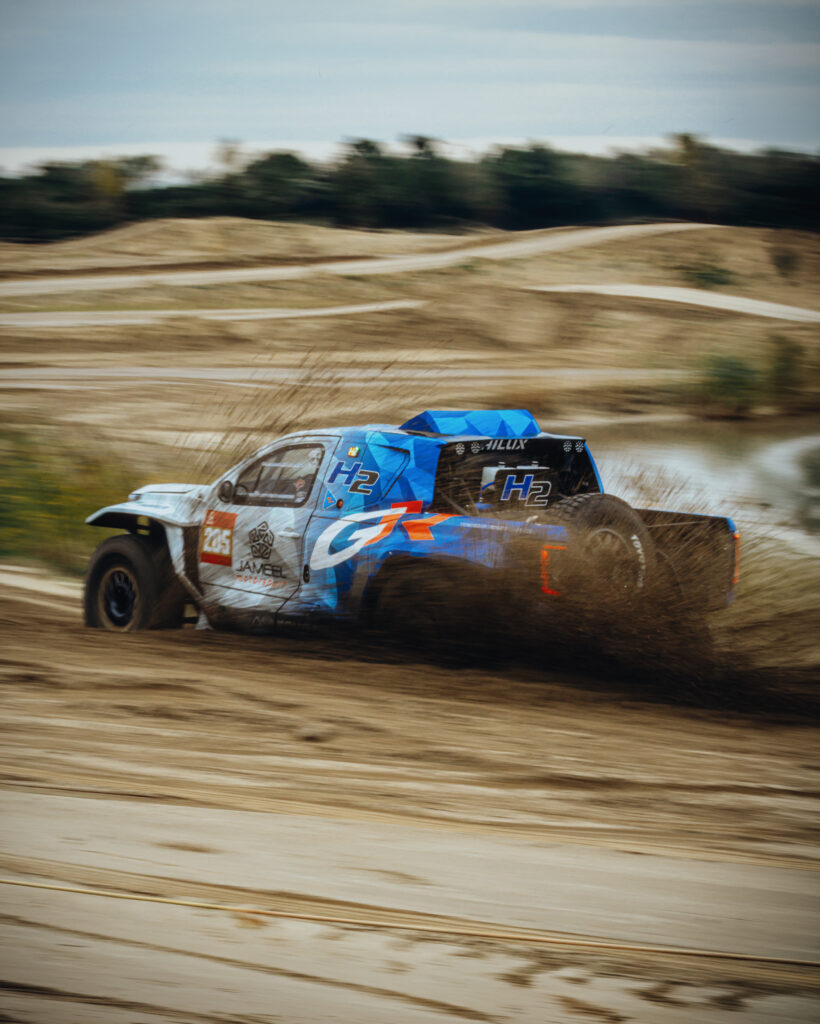
Toyota has finished building a Dakar Hilux with no petrol engine at all. The new DKR GR FC Hilux runs on hydrogen through a 400 kW fuel cell system, and it carries 8.4 kg of hydrogen in four tanks from the Toyota Mirai.
GAZOO Racing announced on 21 October that the truck is built and has started driving tests. It races in the 2027 Dakar Rally in Saudi Arabia, which runs from 1 to 15 January.
Quick facts
- Name: DKR GR FC Hilux, a hydrogen fuel cell electric vehicle (FCEV)
- System output: 400 kW, from two fuel cell stacks combined into one system
- Hydrogen: compressed gas, four Mirai-type high-pressure tanks, 8.4 kg in total
- Chassis: tubular frame from the DKR GR Hilux, double wishbones with 350 mm of travel
- Size: 4,500 mm long, 2,300 mm wide, 2,100 mm high, under 2,500 kg
- Tyres: Toyo Open Country M/T-R
- Driver: Dania Akeel (Saudi Arabia)
- Class: Dakar Future Mission 1000, for experimental vehicles
A race Hilux with Mirai tanks
Under the body it is still a Dakar Hilux. The FC Hilux uses the same tubular frame, safety cell, suspension and brakes as the DKR GR Hilux that Toyota races in the main car class.
The petrol engine is gone. In its place there are two fuel cell stacks that work as one system, a dedicated e-axle and a new high-voltage cooling system. An IAV Dragoon ECU controls it all. Some of the carbon body panels have been swapped for natural fibre ones.
For comparison, the regular DKR GR Hilux uses Toyota’s 3.4-litre V35A twin-turbo V6. Hilux race trucks won the Dakar in 2019, 2022, 2023 and 2025.
Not racing for the overall win
The FC Hilux will not fight Toyota’s own petrol trucks. It runs in Dakar Future Mission 1000, a class for experimental vehicles and new technology. Crews race against the clock on 13 stages with about 1,000 km of timed sections in total, starting and finishing at King Abdullah Economic City.
Toyota says it wants to prove the performance, safety and reliability of fuel cells in hard conditions. Its engineers are focused on four areas: a smaller fuel cell, cooling, durability and energy management. The route has sand dunes, rocky tracks and dry riverbeds, so the cooling work will get a real test.
Who builds it and who drives it
The truck comes from Toyota’s European R&D centre near Brussels, working with Overdrive Racing (the team that runs Toyota’s W2RC effort), TOYOTA RACING GmbH in Cologne and Toyota Motor Corporation. Testing started in Belgium.
The driver is Dania Akeel from Saudi Arabia. She started rally-raid in 2021, finished in the T3 top 10 on her first Dakar and won a Challenger stage at the 2025 Dakar. She also won the FIA Middle East Baja Cup in 2024 and 2025 in a Hilux entered by Overdrive. “In rally-raid our biggest asset as a driver is to be able to race in diverse terrain and conditions,” she said in Toyota’s release.
Burning hydrogen vs making electricity
JDM fans already know Toyota’s hydrogen race cars, but most of them burned hydrogen in an engine. The ORC ROOKIE Corolla H2 Concept started racing in Super Taikyu in 2021, and a GR Yaris H2 did demo runs at Ypres Rally in 2022. In 2024 and 2025 the HySE-X1 and HySE-X2, from a research group Toyota belongs to, ran in this same Mission 1000 class.
The FC Hilux works differently. Its fuel cells turn hydrogen into electricity, and an electric e-axle drives the truck, a bit like a Mirai built for the desert. Toyota calls it its first full motorsport entry with a hydrogen fuel cell car.
Why Toyota cares
The road car is the bigger reason. Toyota has already announced a fuel cell version of the road-going Hilux, due in Europe and Oceania from 2028. Two weeks of Saudi desert should teach its engineers a lot about cooling and durability before that truck goes on sale.
Our take
This is our opinion. A hydrogen truck built on a Dakar-winning Hilux chassis is a brave thing to send into the desert, and we like that Toyota tests it in a real race instead of only on a stand.
The bad side: Toyota hasn’t given the motor power or the range between refuels. Mission 1000 is also a class with few rivals, so finishing is the real test, not the result. And many fans will still miss the sound of the V6.
Your turn
Hydrogen fuel cell or hydrogen engine: which one should Toyota race next? Tell us in the comments.
Sources: TOYOTA GAZOO Racing (official release, 21 Oct 2026), Car Watch (DKR GR FC Hilux built, 21 Oct 2026), TOYOTA GAZOO Racing (Dakar FCEV entry, 9 Jul 2026), Toyota (new Hilux, FCEV from 2028), Wikipedia (Toyota Hilux Dakar wins).
Photos: TOYOTA GAZOO Racing (official press images from the 21 October 2026 release). They show the DKR GR FC Hilux during testing and with driver Dania Akeel.
