Mazda still will not let the rotary die. At Japan Mobility Show Bizweek 2026 this week, it put a two-rotor rotary engine on display, and Mazda staff at the show said the system is still under active development.
It is not a new RX-7 yet. But it is the same type of powertrain Mazda showed in the 370 PS Iconic SP sports car concept, and it comes just before the rotary’s 60th birthday in 2027.
Quick Facts
- What: Mazda “Rotary-EV System Concept” with a 2-rotor rotary engine
- Job of the engine: it makes electricity; an electric motor drives the wheels
- Where: Japan Mobility Show Bizweek 2026, Makuhari Messe, Chiba, 13–16 October 2026
- Fuels: the rotary can work with many fuels, including biofuel and hydrogen
- Power, size, launch date: not announced
- Related concept: Mazda Iconic SP (2023): 370 PS, 1,450 kg, about 50:50 weight balance
Two Rotors, Zero Wheels Driven
The engine sat in the “multi-pathway” area of the shared stand run by JAMA, Japan’s carmaker association. The idea of that area is simple: many roads to lower CO2, not only battery cars.
Mazda’s system uses the rotary as a generator: the two rotors make electricity, and an electric motor drives the car. The engine never turns the wheels itself. Japanese site Car Watch reports that Mazda has not given the displacement, the progress of development or a target date.
Two rotors make more electricity than one. That matters because a single rotor is fine for a small crossover, but a sports car needs much more power on demand.
“Not a Thing of the Past”
Monthly magazine Jikayosha spoke to a Mazda staff member at the stand. The message was clear: this powertrain is not a thing of the past, and Mazda is developing the drive motor in-house as well. Motor specs are still secret.
The magazine also noticed how flat the unit is. The control box sits on the side, not on top, so the whole package is very low. In a front-engined car, that means a low bonnet, exactly what you need for a sharp sports car shape.
This is not a world first. Mazda showed the two-rotor generator in May 2024, at a joint event with Toyota and Subaru about new engines for the electric era. CEO Masahiro Moro said then that the rotary fits well with electrification and carbon-neutral fuels, so Mazda will keep developing it.
The Iconic SP Connection
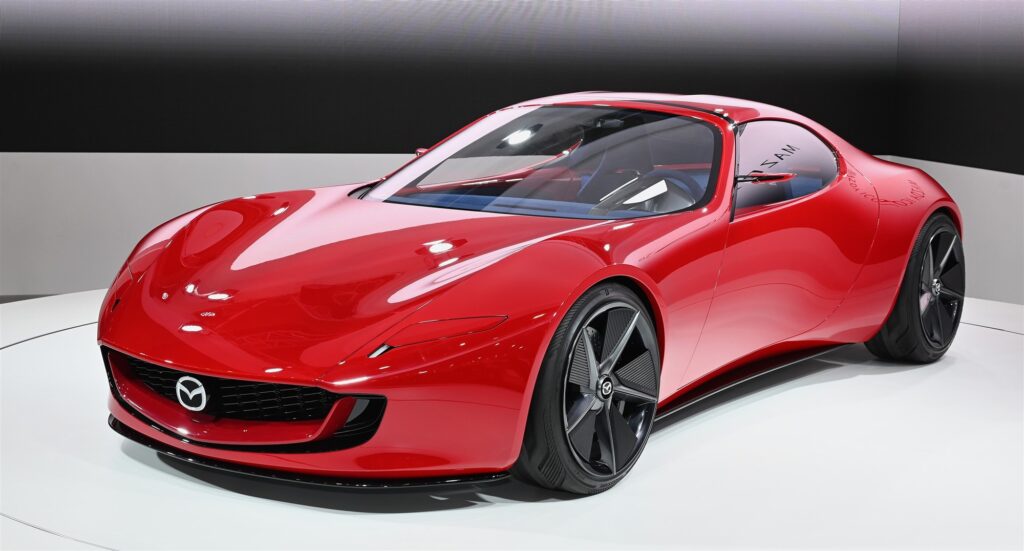
Fans already know where this could go. At the Japan Mobility Show in October 2023, Mazda revealed the Iconic SP, a compact sports car concept with a 2-rotor rotary-EV system.
Mazda’s official numbers: 370 PS, 1,450 kg, a power-to-weight ratio of 3.9 kg per PS and about 50:50 weight balance. It is 4,180 mm long, 1,850 mm wide and only 1,150 mm tall, painted in Viola Red. With its long, low bonnet, many fans quickly called it the spiritual successor to the RX-7.
Mazda has never said the Iconic SP will go on sale. But showing its type of powertrain again, three years later, tells us the project is still alive.
Six Decades of Spinning Triangles
The rotary story started with the Cosmo Sport in 1967. Then came the RX-7 in three generations, the RX-8, and the four-rotor 787B that won Le Mans in 1991. It was the first Le Mans win for a Japanese brand, and it is still the only overall win for a rotary car.
When the RX-8 ended in 2012, many fans thought the rotary was gone. In June 2023 it came back in the MX-30 e-SKYACTIV R-EV, with a new 830 cc single-rotor “8C” engine used only as a generator. Mazda’s total rotary production passed 2 million vehicles in October 2023.
In February 2024, Mazda also brought back a dedicated RE Development Group with 36 engineers. Their work: rotary generators, emissions rules in big markets, and carbon-neutral fuels.
Where It Would Fit
Today, a fan who wants a Japanese sports car buys a GR86 or BRZ, a Nissan Z, or an MX-5. None of them has a rotary. A rotary-EV coupe would be a very different machine: silent in town, then a high-revving rotary sound when the generator wakes up.
Tuners will have questions. With no direct drive to the wheels, the classic recipe of a bigger turbo and a bridge port may not work. Power would come from software, the motor and the battery.
Our Take
This is our opinion: we love that Mazda keeps the rotary on the stage, and a low two-rotor package is exactly what a light sports car needs. The 787B’s spirit lives on in Hiroshima.
The weak point is time. It has been three years since the Iconic SP, and we still have no power figure, no price and no date. A rotary that never drives the wheels will also not please every purist. Mazda needs to turn this display into a real car, and the 60th anniversary in 2027 would be the perfect moment.
Your Turn
Would you buy a rotary sports car if the engine only makes electricity, or is it not a real rotary for you? Tell us in the comments.
Sources: Car Watch (JMS 2026 multi-pathway area), Gekkan Jikayosha (Rotary-EV System at JMS Bizweek 2026), Mazda Newsroom (Iconic SP), Mazda Newsroom (May 2024 engine workshop), Mazda Newsroom (RE Development Group), Mazda Newsroom (2 million rotary vehicles), Mazda Newsroom (787B at Le Mans Classic 2026).
Photos: TTTNIS (CC0), Aos.1905 (CC BY 4.0), via Wikimedia Commons. Photos show the Iconic SP concept, the MX-30 R-EV rotary unit, the 787B and the RX-7, not the JMS 2026 display.
