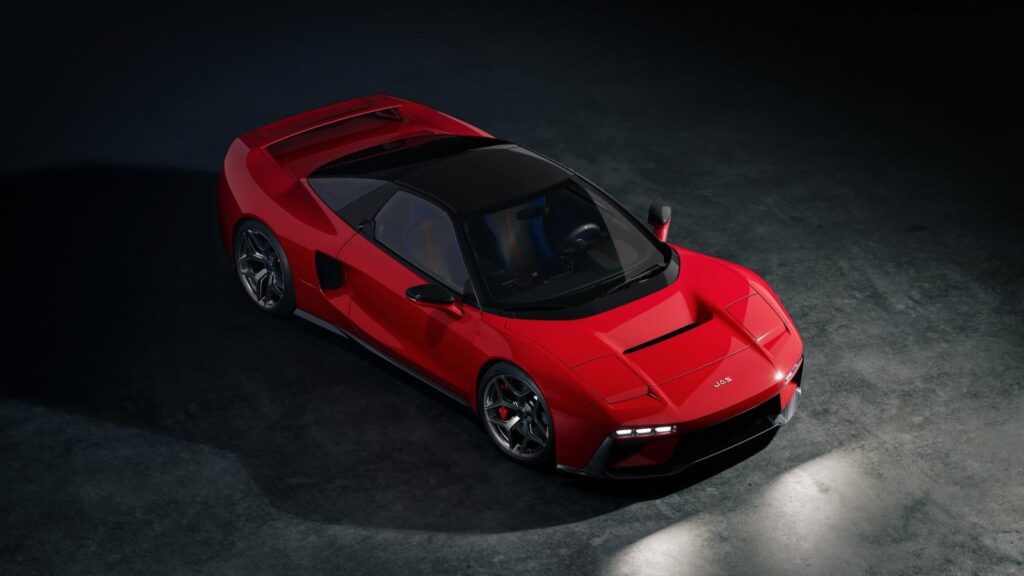
The first-generation Honda NSX has been reborn, and it now revs to 8,500 rpm. The JAS Tensei is a carbon-bodied restomod of the 1990s NSX, styled by Pininfarina, with a naturally aspirated V6 and a 6-speed manual. Only 35 will be built.
The finished car, Unit 001, is making its public debut right now at the Paris Motor Show (12–18 October 2026). The price? About €880,000 before taxes, and you must bring your own NSX.
Quick Facts
- Builder: JAS Motorsport, Arluno (near Milan), Italy, a Honda racing partner since 1998
- Design: Pininfarina, all-carbon-fibre body and interior
- Base: first-generation (1990s) Honda NSX chassis, supplied by the customer
- Engine: Honda V6, enlarged and rebuilt by Judd Power, naturally aspirated
- Power: around 420 hp (reports range from 414 to 425 hp), 8,500 rpm rev limit
- Gearbox: 6-speed manual, rear-wheel drive
- Weight: 1,250 kg dry (claimed)
- Production: 35 cars
- Price: from €880,000 (about $985,000) before taxes, without the donor car
Tensei Means “Rebirth”
Tensei is Japanese for rebirth, and that is the idea. JAS starts with a real 1990s NSX and keeps its soul: the mid-engine layout, the pop-up headlights and the rear spoiler hoop that flows out of the body.
Everything else is new. Pininfarina drew a wider carbon body with LED pop-up lights and a wider track. Inside, the layout still feels like an NSX, but with a digital gauge cluster, a black-and-red cockpit and, JAS says, hundreds of possible trim combinations.
We first wrote about the project in January, when only renderings existed: Honda NSX “Tensei” Restomod Revives an Icon with Modern Engineering. Now the finished car is here.
A Judd V6 That Screams to 8,500 rpm
No turbos, no hybrid. The engine work was done by Judd Power, the British race-engine company famous for its Formula 1 past. Judd enlarged the original 3.0-litre Honda V6 (reports say 3.4 to 3.5 litres) and rebuilt it with stronger internal parts.
The result is about 420 hp, around 140 hp more than the original car’s 280 PS (276 hp). The rev limit climbs from 8,000 to 8,500 rpm. Power goes to the rear wheels through a 6-speed manual with a titanium shifter and a Torsen limited-slip differential.
One honest note: JAS has not published one final spec sheet in English yet, and outlets quote slightly different power, torque and capacity figures. We will update this article when the official numbers are confirmed.
Who Is JAS Motorsport?
If you follow touring cars, you know JAS. The Italian company has worked with Honda since 1998, first as a works team and then as Honda’s engineering and customer racing partner. It builds the Civic Type R TCR and the NSX GT3 Evo race cars, and it says its cars have won more than 900 races and over 100 major titles, including the 2013 WTCC manufacturers’ crown.
The Tensei is its first high-performance road car. In North America it will be sold by Graham Rahal Performance in the USA and Pfaff Reserve in Canada.
Why the Original NSX Still Matters
When Honda launched the NSX in Japan in September 1990, it was the world’s first mass-production car with an all-aluminium monocoque. Honda says the aluminium body saved about 140 kg, and nearly 200 kg on the whole car.
Ayrton Senna drove a test car in February 1989 and told Honda it felt a little fragile. After months of testing at the Nürburgring, the engineers raised body rigidity by 50 percent. That story is a big part of why the NSX is a legend today, and why fans still hunt for clean NA1 cars.
Tensei vs Honda’s Own Restoration
Honda now offers a factory route too. Its Honda Heritage Works program, launched in April 2026, restores Japan-market first-generation NSXs at Takanezawa, the plant where the car was born, and sells reproduction parts worldwide.
That service brings an NSX back to like-new condition. The Tensei is the opposite idea: a reworked NSX with more power, new carbon bodywork and modern parts. In Paris it sits in the Ultimate Supercar Garage next to Honda’s Prelude HRC Concept.
Our Take
This is our opinion: the Tensei is the NSX restomod we hoped for. Naturally aspirated, manual, 8,500 rpm, pop-up lights and real motorsport people behind it. Pininfarina’s design respects the original instead of shouting over it.
The bad side is the price. With the donor car, the total cost will likely go well past €900,000, for a car that no longer wears a Honda badge. The mixed spec figures are also a small worry. For 35 rich collectors, it is a dream. For the rest of us, Honda’s own restoration is the realistic way to keep an NSX alive.
Your Turn
Would you turn a clean original NSX into a Tensei, or keep it 100% stock? Tell us in the comments.
Sources: JAS Motorsport (final design, Paris debut), JAS Motorsport (35 cars, sales partners), Carscoops (specs and price), Motor1, Top Gear, Honda Global (NSX history), Honda Global (Heritage Works).
Photos: JAS Motorsport / Pininfarina (official images: rendering and interior design sketch); 先従隗始 (CC0) and Coolalabright (CC BY 4.0), via Wikimedia Commons (original Honda NSX).
