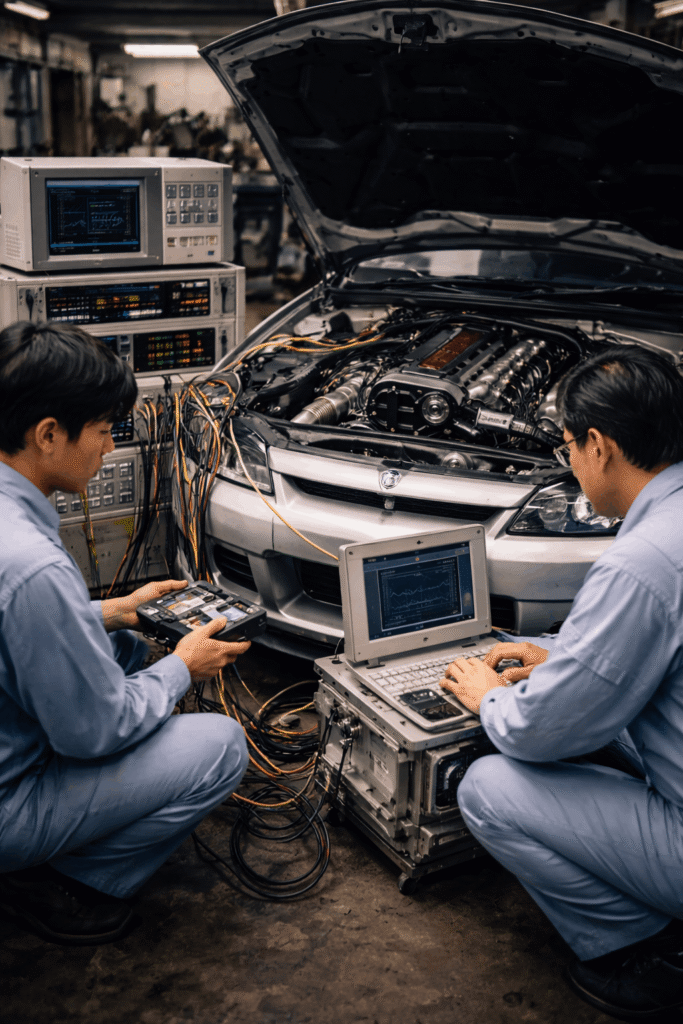
Japanese Domestic Market (JDM) cars are often celebrated for their driving feel and reliability, but their influence goes far beyond enthusiast culture. Many technologies found in modern vehicles today can trace their roots back to engineering principles first refined in Japanese performance cars decades ago.
Rather than chasing trends, Japanese manufacturers focused on efficiency, precision, and long-term functionality — values that later became essential in modern automotive technology.
Engineering Efficiency Before It Was a Trend
Long before efficiency became a global requirement, Japanese engineers were already optimizing engines and drivetrains to extract maximum performance from minimal resources. This approach led to early advancements in fuel management, airflow optimization, and thermal efficiency.
These principles now form the foundation of:
-
Modern engine downsizing
-
Turbo efficiency strategies
-
Hybrid and electric vehicle development
Efficiency was never treated as a compromise, but as a form of intelligent engineering.
Early Adoption of Precision Manufacturing
JDM manufacturers invested heavily in precision manufacturing techniques. Tight tolerances, high-quality materials, and consistent production standards allowed components to operate reliably over long periods.
This focus helped introduce:
-
More durable engine internals
-
Consistent performance across production runs
-
Reduced mechanical variance between vehicles
Today, precision manufacturing is essential for advanced automotive technologies, including electrification and autonomous systems.
Engine Management Systems That Changed Everything
Japanese performance cars played a key role in the development of advanced engine management systems. Early electronic control units (ECUs) allowed engineers to fine-tune ignition timing, fuel delivery, and engine behavior with greater accuracy.
These early systems laid the groundwork for:
-
Modern engine control software
-
Adaptive performance modes
-
Real-time efficiency optimization
What began as performance technology later became standard across the industry.
Lightweight Design and Material Innovation
Reducing weight has always been a priority in JDM engineering. Rather than relying on excess power, engineers focused on material selection and structural efficiency.
This led to:
-
Improved chassis rigidity without added mass
-
Smarter use of alloys and composites
-
Better balance between strength and weight
Modern automotive design continues to follow this philosophy, especially in electric vehicles where weight management is critical.
Reliability as a Technological Feature
One of the most overlooked aspects of technology is reliability. Japanese manufacturers treated reliability as an engineering goal, not an afterthought.
By designing systems that could operate consistently under varying conditions, they introduced:
-
Fail-safe mechanical designs
-
Redundancy in critical systems
-
Predictable component behavior
These principles now influence safety systems, autonomous features, and long-term vehicle durability.
Human-Machine Interaction
Japanese engineers paid close attention to how drivers interact with machines. Control placement, feedback, and responsiveness were engineered to feel natural and intuitive.
This philosophy directly impacts modern technology such as:
-
Drive-by-wire systems
-
Adaptive steering
-
Advanced driver assistance interfaces
Ease of use became just as important as raw capability.
Influence on Today’s Smart Vehicles
Many modern vehicles now rely on a balance between software and hardware. The groundwork for this integration was laid by JDM engineering, which emphasized harmony between mechanical systems and electronic control.
Today’s smart vehicles benefit from:
-
Predictive control systems
-
Optimized energy usage
-
Seamless integration of technology and performance
These advancements reflect decades of incremental innovation rather than sudden breakthroughs.
Why This Matters Today
As vehicles become increasingly digital, the principles behind JDM engineering remain highly relevant. Efficiency, reliability, and thoughtful system integration are more important than ever in an industry moving toward electrification and automation.
JDM engineering did not just influence performance cars — it helped shape the technological direction of the entire automotive world.
Conclusion
JDM cars contributed far more to automotive technology than many people realize. Through efficiency-driven engineering, early electronic control systems, precision manufacturing, and reliability-focused design, Japanese manufacturers helped define how modern vehicles are built.
Their legacy lives on in today’s connected, efficient, and intelligent cars — proving that strong engineering principles never become outdated.
