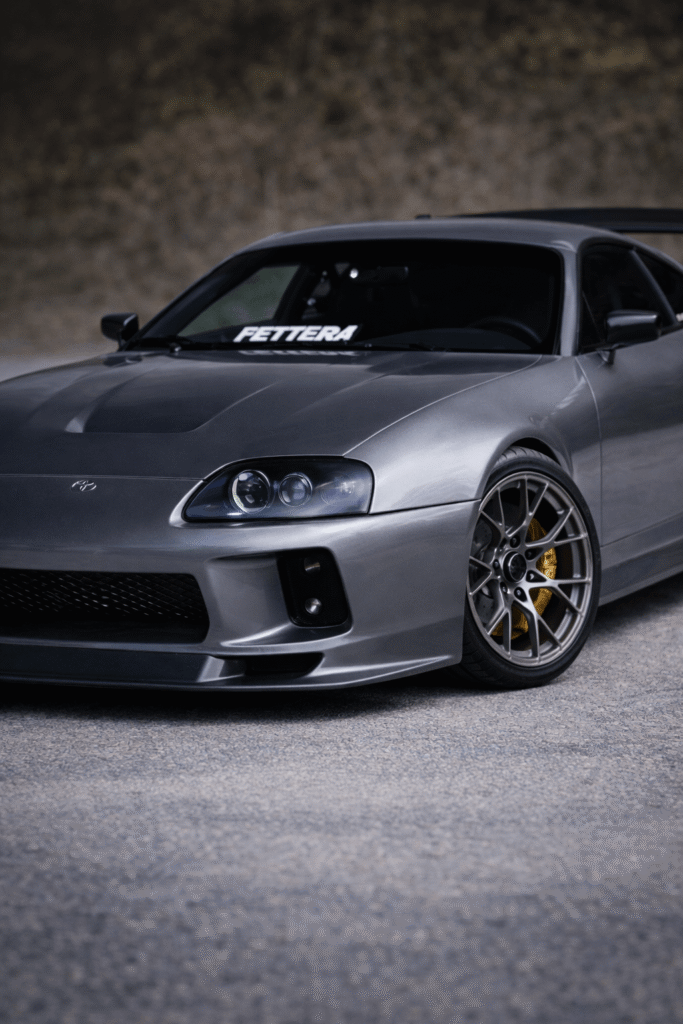
For decades, the Toyota Supra Mk4 has carried a reputation few cars can rival. It wasn’t built to chase hypercars or dominate spec sheets—but somehow, it ended up doing both. Among enthusiasts, it earned a nickname that still follows it today: the nightmare of supercars.
Not because of flashy luxury or cutting-edge electronics, but because of something far more dangerous—engineering that refused to quit.
The Supra That Refused to Be Ordinary
When Toyota released the fourth-generation Supra in the mid-1990s, the goal wasn’t to embarrass European exotics. Yet the Mk4 arrived with a foundation so overengineered that it quietly rewrote performance expectations.
At the center of it all was the legendary 2JZ-GTE engine—a 3.0-liter, twin-turbo inline-six that would become one of the most respected powerplants in automotive history. Built with an iron block, forged internals, and conservative factory tuning, it was designed for longevity rather than headlines.
Ironically, that restraint is exactly what made it unstoppable.
Why the 2JZ Became a Supercar Slayer
What separates the 2JZ-GTE from most performance engines is not just power, but headroom. With proper tuning, upgraded fueling, and stronger turbos, the engine has proven capable of producing four-figure horsepower numbers while maintaining reliability.
That reality turned the Supra into a quiet threat. Cars costing three or four times more suddenly found themselves struggling against a Japanese coupe built decades earlier.
The recipe was simple:
-
Strong iron block
-
Bulletproof bottom end
-
Balanced inline-six layout
-
Massive aftermarket support
It didn’t need exotic materials or complex hybrid systems. It just worked.
Design That Aged Better Than Expected
Visually, the Mk4 Supra has aged remarkably well. Its rounded body lines, aggressive rear wing, and wide stance still look relevant in a world of sharp angles and digital styling.
The design wasn’t trying to be futuristic—it was functional. Large intakes for cooling, a slippery silhouette for high-speed stability, and proportions that balanced aggression with simplicity.
Today, it feels timeless rather than dated.
From Street Icon to Tuning Legend
What truly cemented the Supra’s status wasn’t factory performance alone—it was what owners did with it. Across drag strips, track days, and highway pulls, the Mk4 Supra proved endlessly adaptable.
Some builds focused on raw straight-line speed. Others refined handling, braking, and aero. The platform accepted it all without protest.
That versatility is why the Supra didn’t just survive—it dominated.
Why It Still Scares Modern Supercars
Even today, modern performance cars arrive with more technology, quicker shifts, and advanced traction systems. Yet many lack the emotional connection and mechanical honesty that defined the Mk4 Supra.
The Supra doesn’t rely on computers to feel fast. It delivers speed through sound, boost, and mechanical feedback—qualities that modern cars often filter out.
That’s why, decades later, it still commands respect.
A Legend That Refuses to Fade
Production may have ended long ago, but the Mk4 Supra never left the spotlight. Values continue to climb, clean examples are treated like artifacts, and the 2JZ remains a benchmark for engine durability.
It wasn’t meant to become a supercar killer.
It wasn’t meant to define a generation.
But that’s exactly what it did.
